
Lesson 1.2
The DobieCore Method
✔ Completed
Purpose
By the end of this lesson, you will have five practical rules for working with AI. These rules are not about memorizing tricks. They are about changing how you think about talking to AI so you get better results with less frustration.
Use This When
- You have tried AI and felt like you were guessing
- You want a simple framework to check your prompts before you send them
- You are about to use AI for something important and want to make sure you approach it the right way

Before You Start
Nothing. This lesson builds on the idea that AI works best when you work together.
The Golden Rule
Treat AI the way you would train a new employee. Be patient, clear, specific, give examples, ask follow-up questions, review the work, and refine together.
Think of AI like a new employee. If you hand a new employee a sticky note that says: “Write me a Facebook post,” you will probably get a lot of questions.
But if you say:
“We’re a family-owned bakery in Western Kentucky. Our customers love homemade desserts, and this weekend we’re featuring fresh peach cobbler. Write a friendly Facebook post that encourages people to stop by Saturday morning.”
You’re much more likely to get something useful.
AI works the same way. The goal is better conversations. The more helpful information you provide, the better the results.
The Five DobieCore Principles
-
Start with Your Goal
Don’t ask AI to “write something.” Tell it what you’re trying to accomplish.
Instead of: “Write a website.” Try: “Help me create a homepage that builds trust with first-time visitors.”
-
Give AI Context
AI isn’t part of your business. It doesn’t know your customers, your services, your location, your personality, or your experience. Tell it.
-
Show, Don’t Guess
Whenever possible, upload photos, screenshots, documents, reviews, or existing content you want improved. AI cannot accurately work with material it cannot see.
-
Your First Answer Is a Draft
Don’t expect perfection on the first try. Read the response, notice what’s missing, and ask follow-up questions — “Make that friendlier.” “Shorten that to one paragraph.” “Add a call to action at the end.” Keep the conversation going instead of starting over.
-
Keep Your Voice
AI should sound like you or your brand, not like generic internet copy. If the result feels too formal, too salesy, or too stiff, say so — “I don’t talk like that. Make it sound more like me.” “This sounds like a press release. Rewrite it like I’m explaining it to a customer over coffee.”
Dobie Tip
Perfection is not the goal. Progress is. Your first answer is supposed to be a starting point, not a finished product. The people who get the best results from AI are not the ones who write the perfect prompt. They are the ones who know how to have a conversation.
Follow-Up Questions
- “Which of the five principles do I need to work on most based on how I just talked to you?”
- “Give me one example of a goal, context, and constraint I could use for my next request.”
- “What is the most common mistake you see people make when they first start using you?”
Expected Result
By the end of this lesson you should have:
- The Five DobieCore Principles memorized or posted nearby
- One example from your own business rewritten using Principle 1 (Start with Your Goal)
- A checklist you can run before sending any AI request
- The habit of treating the first answer as a draft, not a deadline
Common Mistakes
Avoid these traps when using the DobieCore Method:
Asking AI to “write something” without stating the goal. (You will get something generic that misses the point.) Expecting AI to already know your business. (It doesn’t. You have to introduce yourself every time.) Starting over when the first answer isn’t perfect. (That’s like firing an employee because their first draft needed edits.) Accepting AI output that doesn’t sound like you. (If it feels wrong, say so and ask for a rewrite in your voice.)
Why This Matters
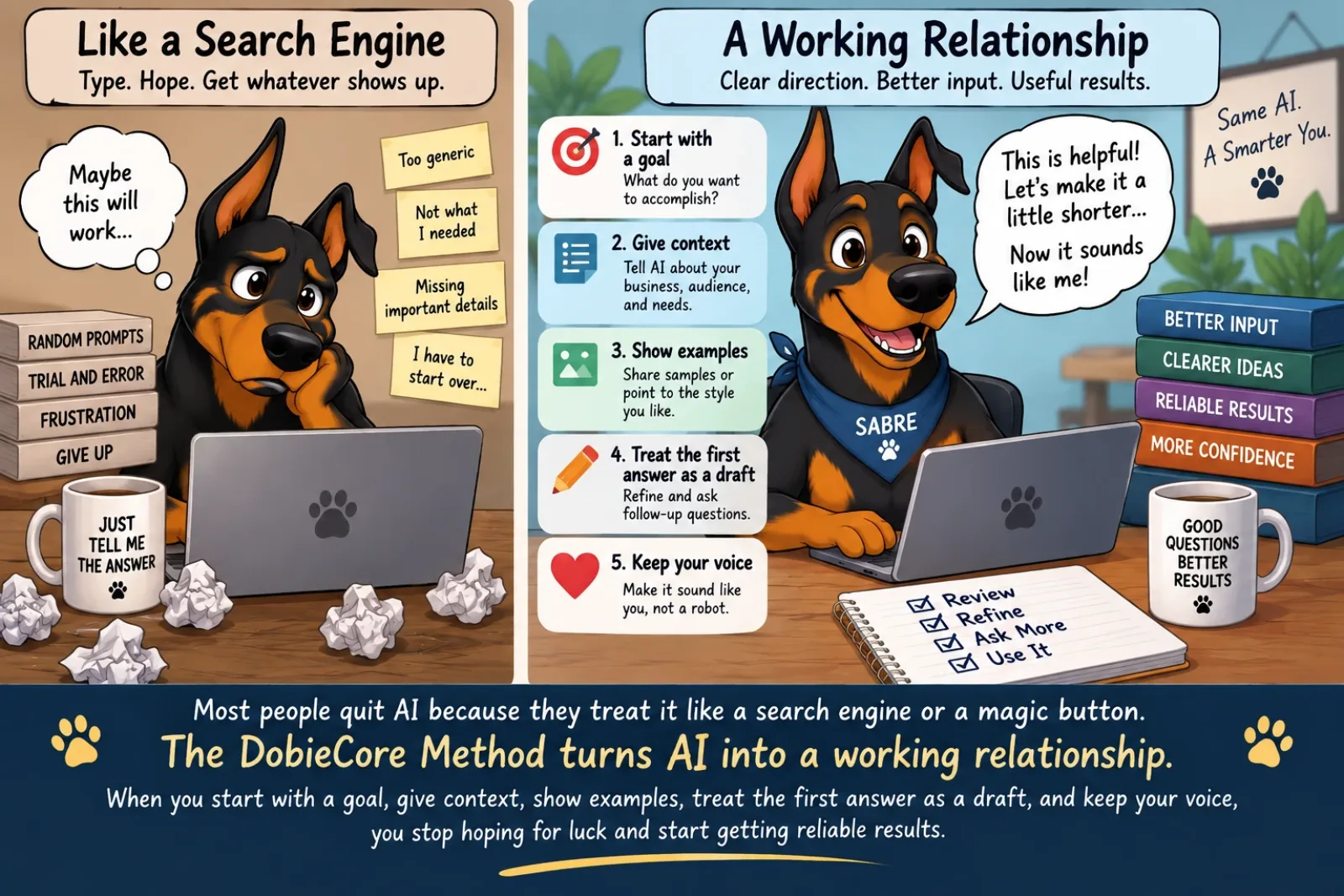
Most people quit AI because they treat it like a search engine or a magic button. The DobieCore Method turns AI into a working relationship. When you start with a goal, give context, show examples, treat the first answer as a draft, and keep your voice, you stop hoping for luck and start getting reliable results.
Save This
Write the five principles on a sticky note or save them in your phone. Run through them before you start any AI conversation:
- Start with Your Goal
- Give AI Context
- Show, Don’t Guess
- Your First Answer Is a Draft
- Keep Your Voice
Coming Up Next
Lesson 1.3: AI Isn’t a Mind Reader. Now that you know how to work with AI, let’s look at what AI actually is, what it can’t do, and why it needs your help to get things right.
Your work: The Five DobieCore Principles
Run the lesson with your AI, then paste what you ended up with — your The Five DobieCore Principles, or the best parts of the conversation. That's what completes this lesson. You can come back and update it anytime.
Sign in to submit your work and save your progress.